The 1970s – Discovery Fairs
Iowa State Fair Historical Timeline
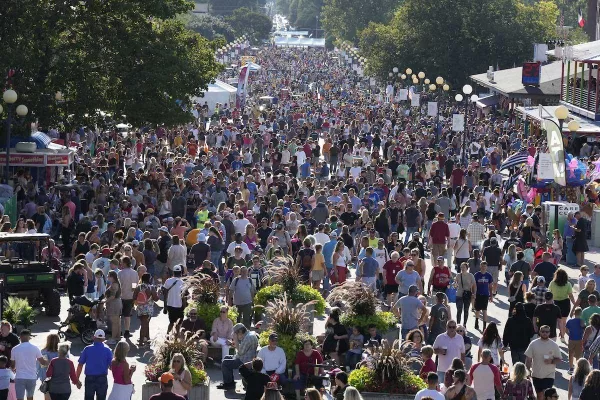
The theme for the 1970 Fair, “Discover Iowa,” challenged all Iowans to discover what their great state had to offer in the way of business, industry, agriculture and entertainment. Several successful firsts occurred during the 1970 Fair including a wild animal petting zoo, demolition derby and a star – Ken Curtis, “Festus” of TV’s Gunsmoke – performing in the rodeo. Lawrence Welk made a return Grandstand performance, along with Engelbert Humperdinck, Red Skelton and Johnny Cash. The Fair hosted the spectacular National Championship Hot Air Balloon Races. The Iowa Arts Council sponsored the first statewide arts festival held during the Fair. Record prices were paid for the 4-H market lamb and steer. Total attendance set a record when more than 665,000 people passed through the admission gates.
A Mexican folkloric show (“an outstanding group of Mariachis flown in from Mexico”), a Mexican market and representatives from the Mexican National Tourist Council highlighted the 1971 Fair theme “Discover Mexico.” The Carpenters, Glen Campbell, Charley Pride and The Jackson Five performed in the Grandstand to huge crowds.
Sonny and Cher attracted the largest Grandstand crowd – 26,200 concertgoers in two shows – at the 1972 Fair. Their record still stands! Other Grandstand performers included Bob Hope, Paul Anka and Bill Cosby. The theme, “Discover Canada,” provided Fairgoers the opportunity to “know their northern neighbors better,” officials noted. While the Fair ended with a small profit, it was not enough to cover repairs and basic improvements made prior to the Fair.
The 1973 “Discover Hawaii” Fair grossed $1,602,267 and was the most profitable in history, netting $286,605. Fairgoers admired paintings of the U.S. Army Exhibit of the Pacific in the Hawaiian Village. Special shows included Zulu, a Hawaiian television and nightclub performer. The Grand Champion Barrow was presented to the people of Hawaii as a goodwill gesture to be used for an Iowa luau in Hawaii. Grandfather’s Farm, an authentic basement barn and part of the original farmstead, opened to the public for the first time and proved quite popular. Stocked with baby animals, it was the perfect setting for antique farm machinery displays during the Fair. Less than a decade later, the barn would be forced to close due to safety concerns; the barn was completely restored and re-opened to the public in 1994. Elton John performed in the Grandstand. Some 15 acres of land were purchased for additional parking; University Avenue frontage was expanded 800 feet.
A three-year series of Fair themes began in 1974 with “The Discoverers,” honoring Christopher Columbus and the land of his birth (Italy) and the country for which he sailed (Spain). The series, commemorating 200 years of American history, ended at the 1976 Fair which celebrated the nation’s bicentennial. New improvements and feature included the Spanish Plaza, Italian Villa, new Plaza Bandstand Stage (now the Anne and Bill Riley Stage) and a new Campgrounds entrance. Heritage Village was officially “opened” by Governor Robert Ray as part of “Heritage Week” held in April. Art, photography, crafts and hobbies were all moved to the former Women’s and Children’s Building, renamed the Cultural Center.
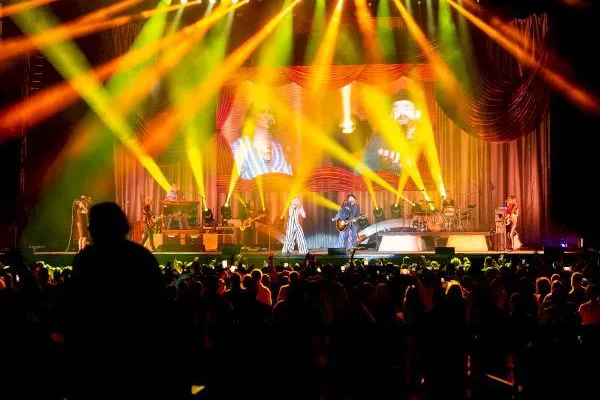
A new Grandstand record was set when Chicago grossed $129,260 - more than any single show in the history of all fairs in the United States and Canada at that time. Other Grandstand crowd-pleasers included Charlie Rich, Redd Foxx and Academy Award-winner Liza Minelli.
“The Colonizers” Fair in 1975 featured the British Isles and presented an exciting British premiere show, including contemporary English singers and artists, authentic folk dancers and a town crier. President Gerald Ford spoke to a crowd of more than 10,000 in the Grandstand. The new Sky Glider gave nearly 100,000 people a chance to see the Fair from the air. Thousands walked the new Avenue of Breeds in the Cattle Barn. A new Machine Arena gave exhibitors the opportunity to purchase time to demonstrate machinery in a 1,000-seat arena.
About Us
- History
- Its Beginnings
- Early Years
- Permanent Home
- Fair Board Created
- Early 1900's
- 1919 - 1929
- The Great Depression
- War Time
- 10-Day Fair
- The 1960s - Heritage Fairs
- The 1970s - Discovery Fairs
- 1976 - 1979
- 1980 - 1989
- 1990 - 1999
- 2000 - 2009
- 2010 - Present
- Conclusion
- Trivia
- Fair Dates
- Fair Buildings
- Photo Album
- Employment
- Volunteering
- Sponsorship
- Daily Attendance
- Green Initiatives
- Blue Ribbon Foundation
- Board Members
- Contact Us
- E-Newsletter Signup
- E-Newsletter Archive

Overview
Its Beginnings
Early Years
Permanent Home
Fair Board Created
Early-1900's
1919 - 1929
The Great Depression
War Time
10-Day Fair
The 1960s - Heritage Fairs
The 1970s - Discovery Fairs
1976 - 1979
1980 - 1989
1990 - 1999
2000 - 2009
2010 - Present
Conclusion