War Time
War Time
Iowa State Fair Historical Timeline
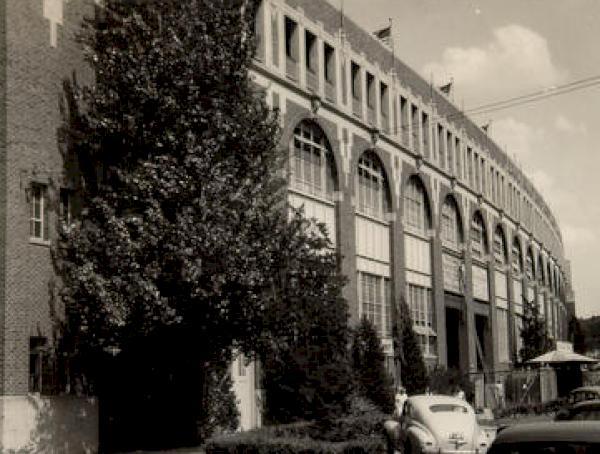
Work on a new $137,000 4-H Club Dormitory (now Youth Inn), a joint project of the Iowa Legislature and the Works Progress Administration (WPA), began in 1940. The Fair’s half-mile dirt track, billed as the greatest of its type in America, hosted 60 top drivers including Gus Schrader, Emory Collins, Ben Shaw and Jimmie Wilburn competing for the world title. The seating capacity of the Grandstand was enlarged to provide room for more than 25,000 spectators at each performance. Famed trumpeter Louis Armstrong entertained. Record premiums were offered in open and 4-H cattle shows.
Daredevil Captain F.F. Frakes, who had crashed an airplane into a house four years earlier, returned to the 1941 Fair to drive his car at 60 mph into a specially-constructed house loaded with dynamite charges and set a fire. A huge victory arch built at the main gate struck the patriotic keynote of the exposition, which also featured an extensive national defense exhibit plus special events promoting “Bundles for Britain.” The tall corn contest debuted and was won by a stalk 23 feet, 2.5 inches tall. Other new contests included an Iowa Quiz Derby for teams of schoolchildren and Iowa’s first statewide Farmers’ Horseshoe Pitching Tournament. The Fair ended with a $75,000 surplus, which was put into a “cushion fund” for future fairs. Lloyd B. Cunningham succeeded Arthur R. Corey as secretary/manager.
The Fair became a wartime casualty in 1942 when the Board turned its many fireproof buildings over to the Army Air Corps at a token rental to be used as a supply depot. Even plans for a limited 4-H Fair were canceled in the interest of gasoline and tire conservation. This was only the second time the Fair had been canceled; the previous omission was in 1898 because of the World’s Fair in Omaha as well as the Spanish-American War. No Fairs were held 1943-45 as well.
After World War II ended, Iowa’s 1946 Centennial celebration provided an ideal theme for the renewal of the Fair. Noteworthy among the exhibits was a display of the nation’s aerial might, plus other weapons and armaments that had helped gain victory for the American Allied Forces. The G.I. Farm Family contest debuted, designed to honor Iowa’s outstanding veteran farm family.
For the first time, the Fair passed the half-million mark despite adverse weather conditions. The event also resulted in the largest profit. The 1947 Fair marked the first full showing of machinery since the end of World War II. Attendance – 514,036 – was the second highest in Fair history.
Attendance fell in 1948, largely due to Fair dates overlapping with the opening of the school year in many communities. The Fair was held Aug. 25 - Sept. 3. More than 3,000 birds were on display in poultry competition.
Livestock exhibited in 1949 reached a new record of 7,107 head. For the first time international recognition was given through the U.S. Department of State’s Information Service.
With operation in 70 foreign countries the department featured the Fair “as a typical American enterprise” and used it “to interpret life in the U.S. through illustrated articles and pictures.”
The new Girls’ 4-H Dormitory (now the Patty and Jim Cownie Cultural Center) was dedicated during the 1950 Fair. The building was paid for entirely from Fair earnings, without any appropriation from the state. The livestock show, called “the backbone of the State Fair,” reached a new record of 7,113 head of horses, cattle, swine and sheep.
About Us
- History
- Its Beginnings
- Early Years
- Permanent Home
- Fair Board Created
- Early 1900's
- 1919 - 1929
- The Great Depression
- War Time
- 10-Day Fair
- The 1960s - Heritage Fairs
- The 1970s - Discovery Fairs
- 1976 - 1979
- 1980 - 1989
- 1990 - 1999
- 2000 - 2009
- 2010 - Present
- Conclusion
- Trivia
- Fair Dates
- Fair Buildings
- Photo Album
- Employment
- Volunteering
- Sponsorship
- Daily Attendance
- Green Initiatives
- Blue Ribbon Foundation
- Board Members
- Contact Us
- E-Newsletter Signup
- E-Newsletter Archive

Overview
Its Beginnings
Early Years
Permanent Home
Fair Board Created
Early-1900's
1919 - 1929
The Great Depression
War Time
10-Day Fair
The 1960s - Heritage Fairs
The 1970s - Discovery Fairs
1976 - 1979
1980 - 1989
1990 - 1999
2000 - 2009
2010 - Present
Conclusion